Monday, May 25, 2015

I am obsessed with Blanchehammer

Blanchehammer. Mr. Shea wrote it. You should read it.

I don't know why I am so thoroughly obsessed with it. It isn't entirely intuitive how things would work. If the players do all the rolling, for instance, and I have some rulings from Pearce about how to attack, I don't know how they roll to defend. Attacking isn't just 'here is the attack roll' - attacking someone defending herself requires, for success, an 11 or 12 rolled on a d12. If you're proficient in attacking with your weapon, you add your proficiency bonus to what you roll, so non-fighters are winning that one on a 10, 11, or 12 at first level.

Actually, fighters (and protagonists) would reduce the difficulty by one die size first, so they're rolling a d10 and succeeding on a raw roll of 9, or 10 at first level; 8-10 if proficient in their weapon, if we define proficiency narrowly. If someone is proficient in 'attacking,' sure, 8-10 with whatever is at hand.

Attacks, Hitting to Wound, Hitting to Kill Speedily

Rulings drill down from there in interesting ways. So wounding someone with a sword is simple - roll a d4, succeed on a 3 or 4, or a 2 through 4 if proficient. Fighters would reduce the die size and basically get that for free. Killing a wounded person is likewise simple. Killing someone with a single blow is only a little tricky - so roll a d8. Fighters, assassins not in a stand-up fight, roll a d6, add proficiency. (Ha, re-reading the proficiency bit at the end of Blanchehammer makes me think it is applied much more narrowly than this.)

So it seems like no one would ever 'just' attack, right? The attack roll is a d10 for fighters, single-blow kills are a d6. Unless the 'one die, one roll per turn rule' makes such necessary - the fighter is trying to kill two people in one turn, so by interpretation 1, she could roll a d6 and a d8 to do so.

I'd probably want it such that wounded people can still fight back - it's easy to wound someone, it's trickier to kill them outright, and defense from a wounded attacker is probably a die step easier. But 'attacking is a base d12, killing someone outright is a d8' doesn't make sense to me, unless either the killing outright at d8 assumes a defenseless person, or we're talking about attacking something that can't be killed in one sword swing or so. Bears, manticores, et cetera.

How to think someone else's idea to death. Also, defense

I dunno, at this point I'm probably overthinking it. Pearce seems to have wanted to show that some things are significantly harder than others, and didn't expect some idiot otaku to take things into the Math Lands. Which will be a new Blanchehammer class at the bottom of the post.

So an untrained attacker can land an attack about 16% of the time, a 11-12 on a d12. So defending yourself works rather well - people should be able to do it rather handily. Perhaps it's simple (d4) or average (d6) - though this means adventurers will land attacks 16% of the time, if not combat-focused, and get injured something like half the time, with a d4, or 2/3 of the time, with a d6. I'd probably go with a d6, just so fighters still have a chance of getting injured in a round of fighting.

Let the DM Roll

How do things change if the DM rolls attack rolls? I'm going to use the 'simple to wound, tricky to kill outright' and just ignore generic attack rolls because why would you do that. If I roll to wound as a fighter, I auto-hit, if we reduce d4 to 'success.' My opponent, a fellow fighter, wounds me. I can automatically finish my opponent off (because I won initiative), but I am still wounded. Any fighter-equivalent or assassin or protagonist can finish me off quickly, easily, automatically. I could mayhap win initiative and go for broke, go for a quick one-hit kill, but if I lose initiative I am dead.

This sounds like a grim system built for players controlling more than one character, or having a posse, or both.

Having played systems where the DM doesn't roll, and systems where the DM rolls, I like the latter better. The former tends towards two simultaneous systems, one set of rules for what the players do, and anther for how the DM's world works. If you give a player an NPC to play for a bit, the NPCs stats are written in a completely foreign language, at least from when I've played Numenera. An NPC doesn't roll to get things done and could only auto-succeed or fail in that system, with ties determined randomly. I'd rather have NPCs that can be elevated to PC status without an act of translation, personally. I also think this dual track creates PCs that are more complicated than NPCs, which I don't love.

I like PCs that aren't terribly special. Other than their amoral penchant for clever ways of dumping on their enemies.

On the other hand, if a PC wants to run away from someone else, who rolls what? There is no DEX in Blanchehammer. This is just a matter of on-the-spot rulings based on what the players have been led to expect, which may be the whole point of Blanchehammer. I'd probably let the PCs roll and see what happens, and not worry about rolling for the NPCs here. NPCs flee, I'd probably let the PCs roll to pursue. There are some neat ways of resolving chases that are more complex, but this game can probably roll with a simpler setup.


Idiot Otaku of the Math Lands

A Blanchehammer class:

Idiot Otaku of the Math Lands have an easier time boring people into semi-magical slumber or confusing people with half-sensible verbal logic flowcharts, and escaping from them thereby (and by running). So producing a semi-magical slumber is only tricky for them, as is their fast-talk confusion logorrhea.

Idiot Otaku comb the deserts known as the Math Lands for bunkers of illicit, collector-quality hats of the 2nd Imperium of Man. These hats are, of course, outlawed by the Emperor, but the idiot otaku are adept at avoiding capture. They are not adept at desert survival. Their posse consists of pupils, as per the sage, or stoned chaos monks who are armored if showing off their abs, and adept at nonlethal combat maneuvers and finding devices that play Death Metal. 

Monday, May 18, 2015

3 Snake Leaves

I've been reading through Into the Odd lately, and also found an awesome webcomic via a fellow player in John Bell's awesome Necrocarcerus campaign. That webcomic's titular conceit is destined to be an Into the Odd Arcana.

3 Snake Leaves

If all three leaves are present and pressed over the eyes and mouth of a recently dead, largely intact corpse, the person will be flush with life and vigor. So much so, that they make choices they come to regret. At the Referee's discretion, players should roll a WIL SAVE or misbehave as befits their ebullient nature.


I would probably only let the 3 Snake Leaves work once on a PC, and after it does it's work, it's obvious the person isn't quite the same as everyone else. They're too flushed with blood and life.

Monday, April 27, 2015

Independently-Minded Skeleton Tactics

From several editions of DnD, it appears skeletons are typically written as dopes who clackingly follow orders at best, or, at worst, repeat the actions they carried out in life.

Unless their job in life was operating a Rube Goldberg machine of violence, pulling levers to expel burning oils and shoot out pincer claws, this is Not Good Enough. Not by half.

Skeletons need to be smart, dammit, and they need tactics! They, of all the undead, are vulnerable and have relatively low hitpoints, especially compared to the other low-level undead, zombies.

Why Are The Skeletons Smart Though?

  1. Wizard with strange politics created them in order to free them; awaits emergence of higher order through giving skeletons more intellect and reasoning capacity.
  2. Dully glowing gems chained to their vertebrae grant them decent cognition.
  3. Undead brains, burnt and charred to the inside of their skulls in hideous diagrams, afford them a hive consciousness. In groups of 3 or more, the skeletons are quite smart. 'Groups' can be separated by a few hundred feet and retain awareness via one another's senses. This also makes them harder to surprise.
  4. Teeth and jaws stained black by a vicious, viscous liquid which allows undead more self-awareness, with occasional bouts of crippling paranoia. The stains become a warning.
  5. Partial revenanting gone wrong, giving the skeletons eyes in bleeding sockets, boiled (yet largely functional) brains, scraps of flesh on their bones still. Claw-like hands work as weapons.
  6. Devouring the brains - or in their case, mastication alone - has made the skeletons more intelligent. They communicate in morse code by clacking jaws or phalanges against femurs.

Skeleton Small Unit Tactics

Skeletons like to have zombies around as meat shields. They'll chain zombies up and stagger them in rows before them, hiding behind them. This counts as decent cover in whatever way you estimate it, though attacks that miss have at least some chance of hitting a zombie instead. The skeletons fire short bows from behind this mobile cover. The zombies are chained to them with shackles or ropes which allow the skeletons to let one or more zombie loose; they'll do so if their opponents seem to be concentrating fire on them, rather than on the zeds. 

Skeletons will deglove zombies in (frequently successful) attempts to harvest a new skeleton warrior. Degloved tissue will be fashioned into crude armor - likely not improving AC so much as granting the skeleton more hit points, or ameliorating some of their vulnerability to blunt weapons.

Some skeletons' bones aren't connected by anything other than magic or electromagnets. This requires some setup, but in an area with an ancient, whistling pneumatic tube system, skeletons will 'mail' themselves about via tube, arriving in a jumble and self-assembling in 1d4 rounds. In other situations a skeleton will dive behind cover as a loose jumble, providing a small AC bonus. If the bones can land on something soft, falling from a long distance only inflicts half damage.

Skeletons will, of course, throw Greek Fire or ball bearings or caltrops at opponents who are fleshy. Caltrops have no effect on skeletons, other than making their kicks do slightly more damage, should the caltrops get stuck in their metatarsals. These can also aid climbing, which skeletons are adept at (I'd let them succeed on that in a 3+ on a d6 roll). Their toes and fingers are quite suited to teasing out tiny holds during an ascent. 


Skeleton Mass Unit Tactics

Former tinkerers or engineers or sappers probably exist among a large skeleton force. They will make a big show of attacking, leading with zombies and seeking to avoid prolonged engagements, while sappers mine and undermine fortress walls, or while engineers construct trebuchet out of wood and spare zombies. 

They don't get hungry, they don't sleep, they can see you in the dark, they have trebuchet. You better hope in a prolonged siege that their sentience somehow causes some intellectual schism.


Thursday, April 16, 2015

Morlocks

If you don't have the occasional Drill City grinding through your setting and disrupting your precious shit then get one set up and rolling through.

ALSO, if you run around in my campaign, GO AWAY. I'm probably going to throw in things I don't want y'all to have.

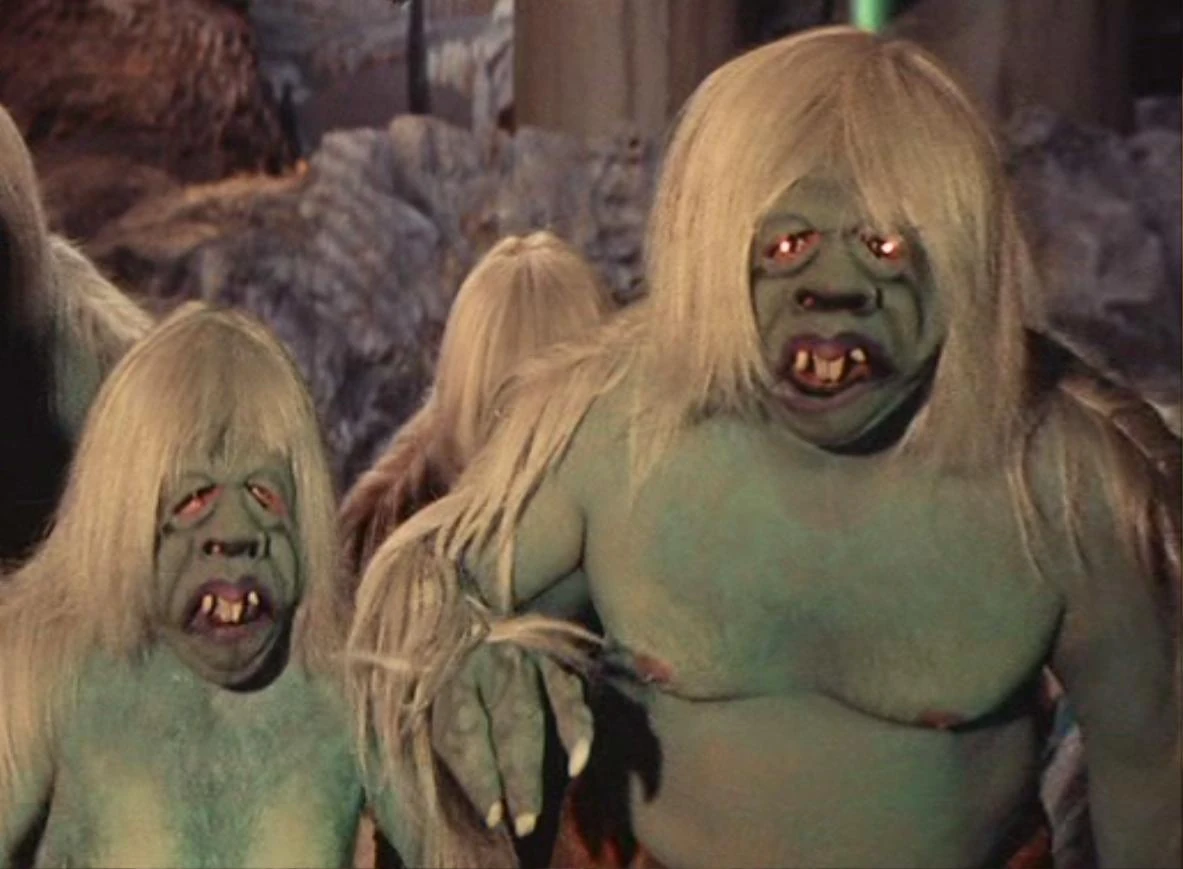
So, a Drill City is tunneling out of the Plane of Towers and towards Necrocarcerus. Clearly you need the PCs to fight some Morlocks.

What Morlocks Are Not


This is clearly surface-dweller propaganda. Morlocks are not stupid or primitive. They have a fucking drill city! It's a city! With a DRILL ON IT! And it's coming for you! Your city walls will not stop something that can grind through the Underworld and the Underdark. They're not going to get to a stone block wall and turn around in shame. They are going to come in and rule you and destroy your civilization and enslave you and eat you. Because you are Eloi: you are soft, you are weak. The Morlocks hate you more than they hate each other. Barely.

Morlock Hate Priests

They love to use Command on surface dwellers. They love to make you kneel in their presence. They worship machines of their manufacture, but most of all, they worship Hate. They brew up healing potions of cloned Eloi blood that can heal 2d4 + 4 hit points, but only if you make a Constitution check to keep it down. Otherwise you get half of the effects and are filled with rage.

They are the peak of the Morlock caste system. They have a direct line with the Big Rage Upstairs and are listening for orders to return to the awful surface. They are also, in many cases, complete buffoons, eager to order their peons to glory, or at least horrible death. They are crafty in all the ways of staying alive and putting other Morlocks in danger. An expedition of Morlocks on the surface will be lead by a Hate Priest who lost some political infight, and was forced to leave the protective shell of the Drill City.

Morlocks in Battle

All Morlocks can tap into the Minute of Hate. They become resistant, in 5E terms, to piercing, blunt, and slashing damage, taking half of whatever people roll. They can keep this unnatural resilience up for a minute, then have to take an hour's rest to regain their smoldering disgust for existence. 

Despite this, their fighters are not eager to wade into melee - like the Hate Priests, they'd rather someone else take that roll, preferring instead to fire bows or pistols from cover. But they are adept at using cutlasses and pikes in close quarters. 

Priests, Guards, and Crew

The Morlocks who are not trained as fighters or reared as acolytes become crew. And the crew is ground down over time, like the Urth beyond the city. Their quarters are stacks of tiny berths, like a Japanese coffin motel built for Iron Maiden groupies. Bedding is quite basic, and communal baths are one of the only comfortable places in the Drill City for these lower-class folk. Regardless, they largely do their duty, focusing their red-eyed gaze on the Eloi. Largely.

Drill City Thieves Guild

A Drill City contains miles of iron hallway and pipe. Inevitably Morlock engineering creates, as that angry discipline always must, strange crevices, strange pockets of unused space, off the beaten path. Some Morlocks are drawn to these places, shirking the rigorous requirements of the upper caste. They might still work, but they're goldbricking when they're not actively stealing food or components for their own purposes, building up a tiny fiefdom between the steam-reclamation manifold and the primary waste filter. They'd love nothing more than to take over, eat the priests, and then probably recapitulate the same shit system all over again. But they typically stay themselves from committing outright rebellion, if it seems the priests will put more Eloi flesh on the table.

Morlock Cuisine in the Underworld

They have frozen in blocks, Eloi, or pieces of such. They take little pieces and clone them in vats, growing turgid lumps of flesh. Thawed surface-dwellers can become henchpeople or backup party members, as long as they can carve revenge into their captors and cooks. 

Morlock Stats

You've probably run DnD or similar games for longer than me; you can probably come up with better stats than I can. The Hate Priests are actual Clerics, or at least, cast Cleric spells. The thieves are thieves and will shank you. The fighters throw bottles of oil and snipe at you from behind turned-over workbenches, while their 'leader' Hate Priest sings a disturbing hymn.

Wednesday, April 1, 2015

On Wanting Everything and Abandoning Established Settings

I have run away from an established setting. I have done so because I find reading lots of pages of text about an imaginary setting to be somewhat dull, at times. As Zak S hath wrote: if you write RPGs for a living, the work you put into a novel-like world description is just never going to be your most amazing work. Your most amazing work is wedged somewhere in systems of classes and rulings and tables, in character options and maybe in vignettes of people and places and things. But a fully detailed setting isn't a vignette. It's more of a textbook.

A fully established setting becomes something of a weight. Players expect to see it. They know a bit of what to expect - and I don't mean to get into some missive about the horrors of metagaming, because I'm not terribly worried about it. But unless you're explicit that you're diverging from canon, players may interpret differences as a mistake on your part.

This talk of fully-detailed settings reminds me of Basic Red's Let's Talk About Moon Slave, which in addition to establishing a kick-ass deity, talks about how RPG writers get deities wrong. Rather than a vignette, you get a list of things the God holds in his or her bailiwick. Or you get novelized fictional treatments that become textbooks for the DM to memorize.

I can't hold too much in my head. It doesn't help that every time you damn people in the RPG blogosphere write something down, I feel like I have to use it. I'm already running 5E players through the Plane of Towers. Then I thought, what's tower-shaped that I read about recently? Oh, I know: a Morlock Drill City!! So now the PCs are in a drill city's theater, getting made up and stuck in black theatrical unitards, about to contest both Morlock and the zombies and skeletons that have infested the city. According to a crazed, evil, yet affable (thusly) morlock wizardling, the Plane of Towers is a place in Hell, which of course lies underneath the world. The Morlocks just got a bit side-tracked on their journey to the surface when they accidentally took on a small horde of the undead.

And since the players are in a form of hell or purgatory - the Plane of Towers isn't that bad, after all - maybe they'll drill 'out' / through a portal / into Necrocarcerus. Ultimately I want to ask for some of their input about what they want from an overworld setting, but I like a) lots of people are 'undead' and b) the setting has a freakin time-limit on it.

Monday, March 16, 2015

New Campaign: 5E and all the OSR things that inspire me

If you're a player in my game, just.. be an adult! If you read this stuff you're going to have some metagame knowledge.


We begin in the The Plane of Towers. There are other humans and demihumans there; feel free to roll for what kind of murderhobo you find if the NPC has been stuck in the Plane for a long time.

PCs can find ways to escape and get to Vornheim or Ur Hadad, or Stalag, a Deep Gnome city's peak beneath the Universities of the Cthonic Codex. All of which I imagine existing in the same world.

Things that I want to inspire this campaign:

Dreams in the Lich House's Taenarum

DitLH's Black City project as well

So from these two, whatever city the PCs arrive in, they'll find or hear of some megadungeon just outside the city. If they want, they can travel there easily enough. Elsewise they can pointcrawl the city. Backswords and Bucklers may give me some ideas for city roguishness.

In terms of gonzo: Kalak-Nur is pretty inspiring to me.

I think Dreams in the Lich House really inspired me to play this using 5e Dungeons and Dragons. I think there will be a few minor modifications to test out in the Plane of Towers (characters run or have access to a small pool of characters, weapons and armor degrade) Definitely want XP to come from more than just combat, as well, to incentivize the players to hand me conflict edit: by being rogues and trying to sneakily get gold. (Originally I linked here to the blog of someone who I used to respect, but turns out he was an abusive shite.) I dunno, perhaps for now I won't mess with the XP system. Other than awarding XP for things like 'Achieving Important Goals' and 'Outwitting Enemies Such That Fights Aren't Needed.'

I recall someone running Vornheim and the players remembered Sharn, from the Eberron setting in DnD, but they couldn't actually recall that the city's name was Sharn; they were calling the city of Sharn 'the Eberron setting.' I can't recall if this was good or bad. On the one hand, Sharn is kind of the megacity of Eberron, so I can see people remembering the setting as this unique city. On the other hand, it'd be nice if people remember the difference between The City and The Setting, especially if they leave the city.

I want to make sure that each city has its own personality, on top of whoever the PCs are talking to / destroying. Vornheim is Cold. It was extruded slowly from the frozen Urth, and it will linger for a long time. It was made by ancient Men in ways we cannot easily replicate, but can repair. Ur Hadad is Mad. It is jovial as a rictus grin, its hallways and passages carved well before mankind, for reasons we cannot know. It is populated by jovial killers and stifled bureaucrats who think laws are the best way to play practical jokes.

Stalag would be my own making and has the most development to do. The deep gnomes are a contemplative, practical lot. They negotiate with everyone and act as middlemen. It is slow there, plodding, and quietly besieged. Drow and duergar maneuver around it, wanting it for themselves. There are lots of illusions, lots of the environment trying to twist around on the PCs, which would be damn hard to model. Definitely going to give the PCs some indications that 'this will lead you out of here this way' and let them decide how to leave.

Tangentally, Things missing from the Plane of Towers

Ant Tower as given to me by this lovely post on Giant Ants.

Crystal Tower filled with crystal golems (using the Animated Armor from the 5e monster manual). A level 4 magus who created them. His murderhobo captives who are turned into living-heads-in-jars which are in turn used to power the golems. Inside each one you can see the face of someone. They seem to be screaming.

Needless to say, the PCs could soon have a murderhobo goon squad to go upstairs and wreck that wizard. Then, the problem is, the PCs have a murderhobo goon squad...

A besieged tower. This would probably let me use some of the mass combat rules from Red and Pleasant Land. I have to poke in there and see how those jive with 5e, and how to make horses/mounts super important for traversing a battle. I believe Zack already had that in there.

Regardless, inside there are nobles who have never left their tower and who typically dine on blood and peasants. Outside are a bunch of rabid humans who are there to knock over the tower. Many of them are foaming at the mouth and all are crazy evil.

What is it like after we die


Tom Waits had some good ones.
  1. Like a skinned hand bleeding
  2. Like a back door squeaking
  3. Like a big dog breeding
  4. Like more cold coffee
  5. Like a new brain learning

Far Less Lyrical:

How NPC reacts to being dead
  1. Thinks he died doing something heroic and worthwhile. Enemies are beneath him - he won, after all.
  2. Remembers everything.
  3. Remembers nothing. Every 30 seconds or so, new introductions.
  4. Has achieved Nirvana. Questions about pragmatic issues get nebulous cosmic answers, questions about nebulous cosmic issues get pragmatic answers.
  5. Can't hear you very well over the sounds of a huge party / orgy kind of thing. Gives lots of unsolicited romantic advice.
  6. Can't stop screaming. Can speak at length of how torture works when one cannot die of shock.
  7. Keeps thinking of his/her parents, wondering when they'll show up. Has a message for them.
  8. Sitting at the right hand of God the Father, Our Dark Lord.
  9. Watching you, waiting for you to join him/her.
  10. You look like an angel to them.
  11. There's a lot of interference over the short-wave. The NPC is about to lead a counterassault against a heavily fortified nest of devils. Getting mortared as we speak. Advice on tactics would be greatly appreciated.
  12. The NPC is now mining in the Knowledge Mines alongside angels and devils. There are a number of esoteric topics the NPC has since become an expert in; uses metaphors from his prior work to explain them. Law and Chaos can be explained with sheepherding metaphors. Don't worry if this doesn't make sense. The PCs are probably not experts in either topic.
  13. There is a cup of coffee before the NPC, on a table in a field. Clouds roil across the sky. Shapes form in the clouds.
  14. The NPC has a tower on the Plane of Towers. Some of the local imps worship the NPC as a godling. The NPC has gotten used to this treatment.
  15. Relives last few moments forever. PCs can break this loop with a tricky persuasion roll / proper roll-playing.
  16. NPC is distilling soul-stuff in a brewery for the Gods. Doesn't have a lot of time for chit-chat or will be fired.
  17. The NPC was already re-born into another mortal body. Doesn't recall past life, is extremely weirded out by your 'telepathy'. New mortal body: 1) humanoid baby of some specie 2) goat 3) golem 4) already-adult goblin 5) eagle 6) snail
  18. Busy catching up on reading. Will talk if the PCs can hit a Lore roll (or equivalent) to discourse on the Symbolism of the Moon Slave in relation to the 18 Days War.
  19. Doing the same stuff, now just in Dis. Once an NPC, always an NPC.
  20. In an awesome bar, drinking and bullshitting.
  21. You can clearly hear some kind of play in the background. The NPC whispers and the play bits you overhear seem more relevant answers to your question that what the NPC says.
  22. Compelled to return as a lantern in an Iron Empire outpost. Will give answers if the PC will get geased to come out and smash the lantern. Which is, of course, Damaging Imperial Property and Rather Illegal.